"This is a wonderful beginning of a music of the 21st century where the composition is yet spatial."
Peter Weibel (artist talk 2016)

"This is a wonderful beginning of a music of the 21st century where the composition is yet spatial."
Peter Weibel (artist talk 2016)
Aura calculata is a water organ sculpture consisting of 18 glass organ pipes arranged in a circle. The pipes control their activity depending on the activity of their immediate neighbours. They are connected to each other by cables. Similar to a Mexican wave, a fixed set of neighbourhood rules determines when a pipe is active, i.e. when it lights up and plays a note. Only the signal to change state is still specified externally.
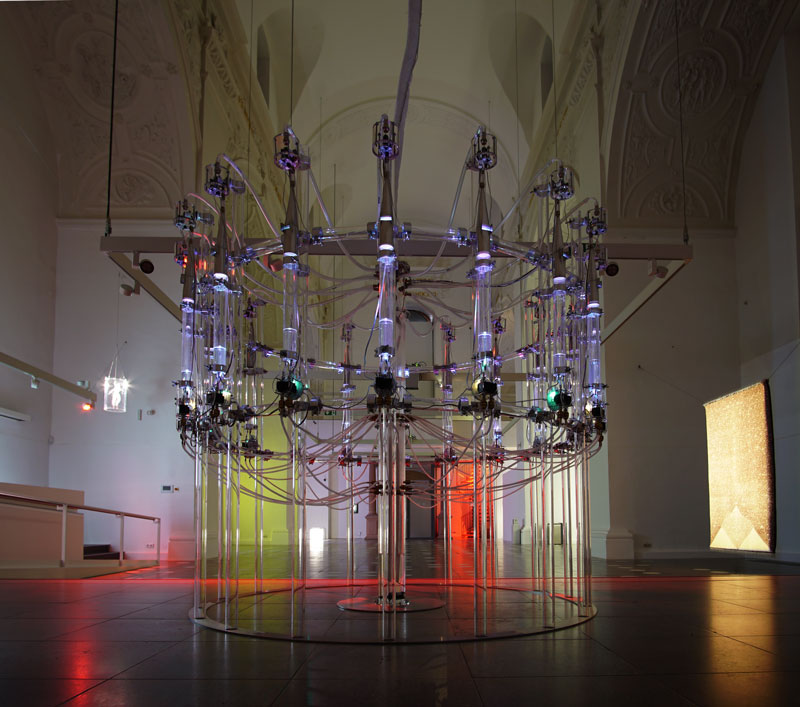
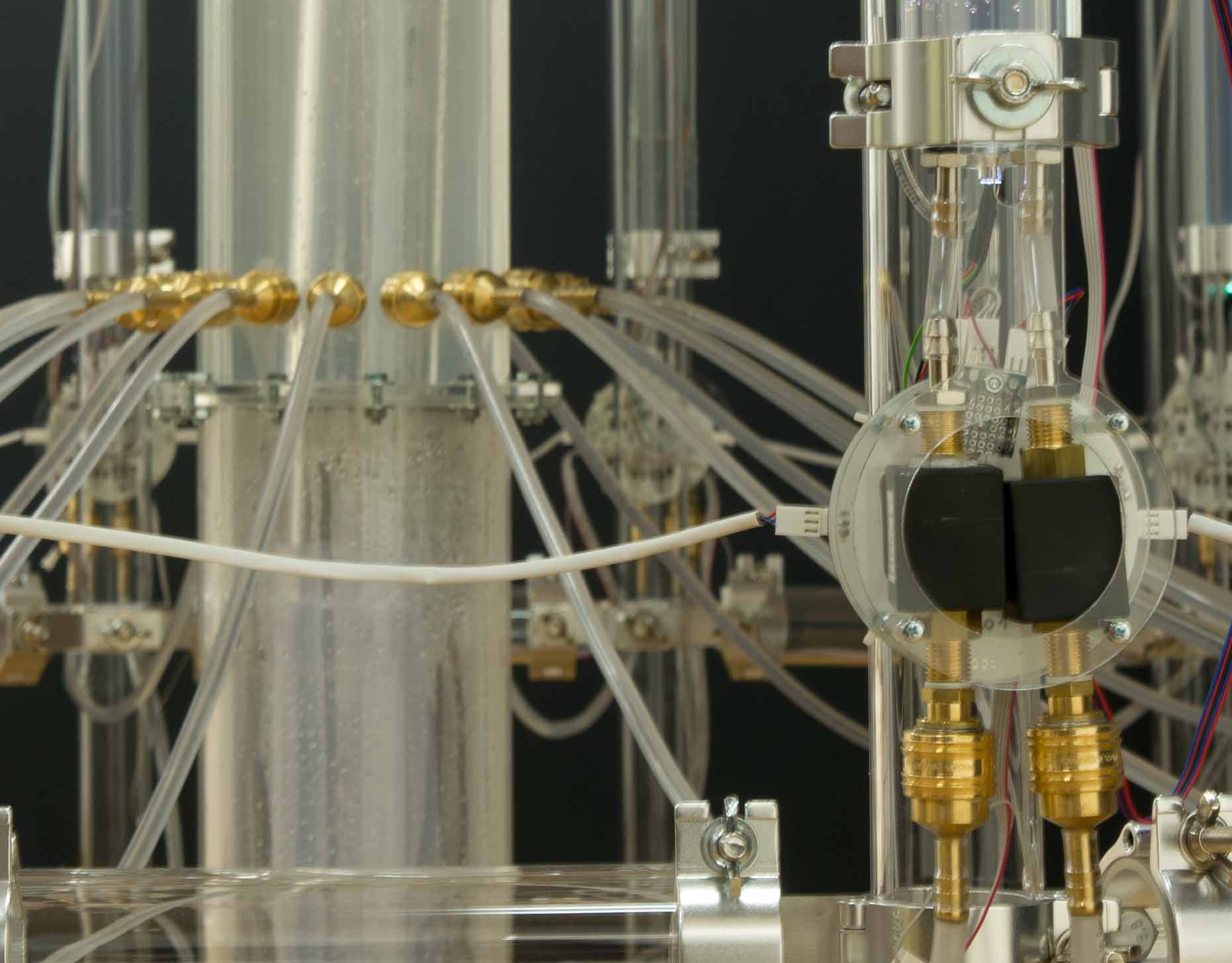
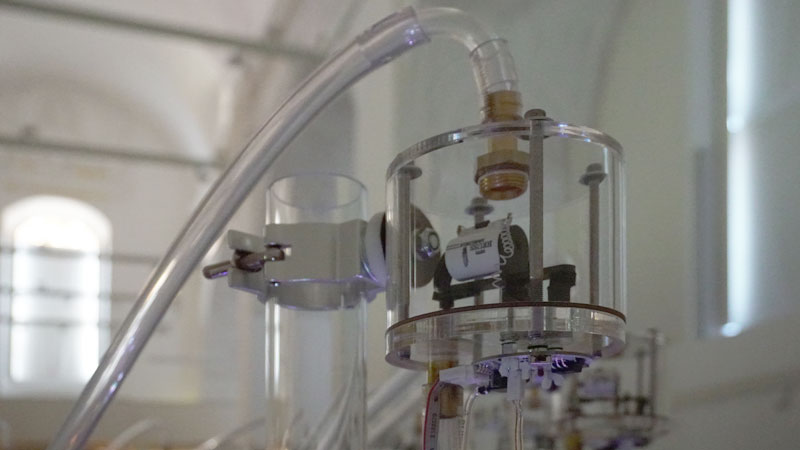
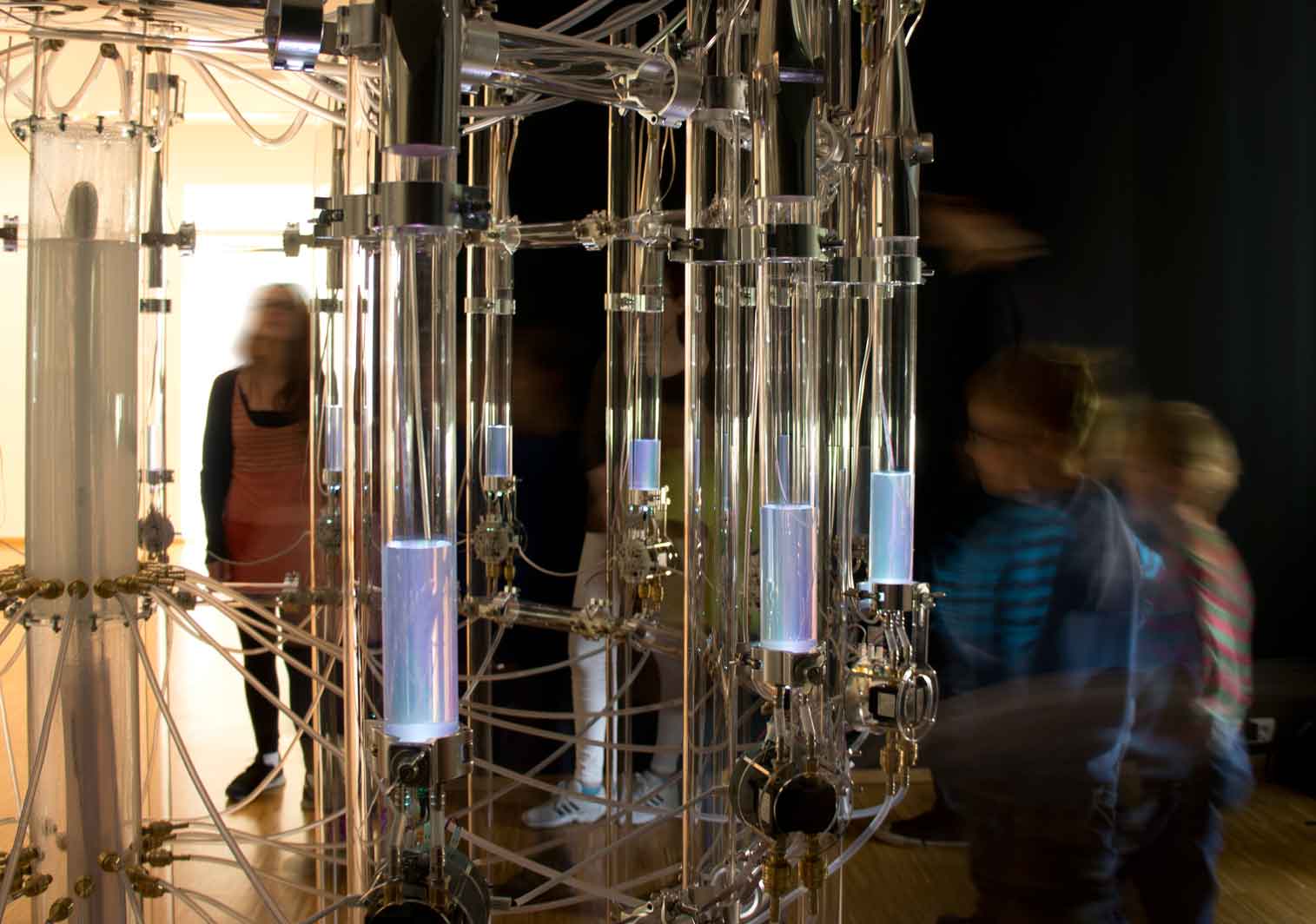
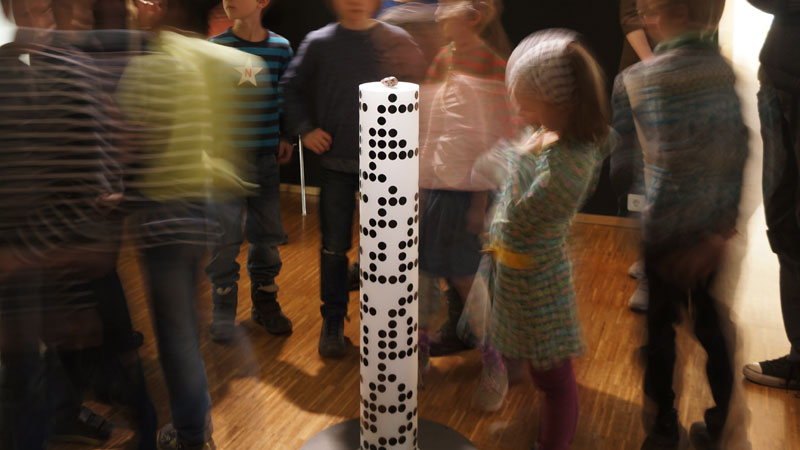
Sonorous hydro-logic Each pipe also analyses its own activity: the water column in the pipe body – and thus the pitch – rises or falls depending on how active the individual organ pipe has been in recent states. The pipes are fed from a water reservoir in the centre. Water can flow in and out via a valve system. At the beginning, all pipes fill up when the inlet valve is opened and the pipes fill evenly due to the water pressure of the reservoir in the central column. When the organ begins to play, all pipes have the same fill level and play the same note.
Timbral play The changing fill level of the pipe not only alters the fundamental tone and thus the pitch of the sounds excited by wind (Latin: aura), but also the respective timbre. In this way, the tones overlap in the room, repeatedly forming beats and weaving a continuously changing tapestry of sound – an extension of the organ instrument by a microtonal dimension.
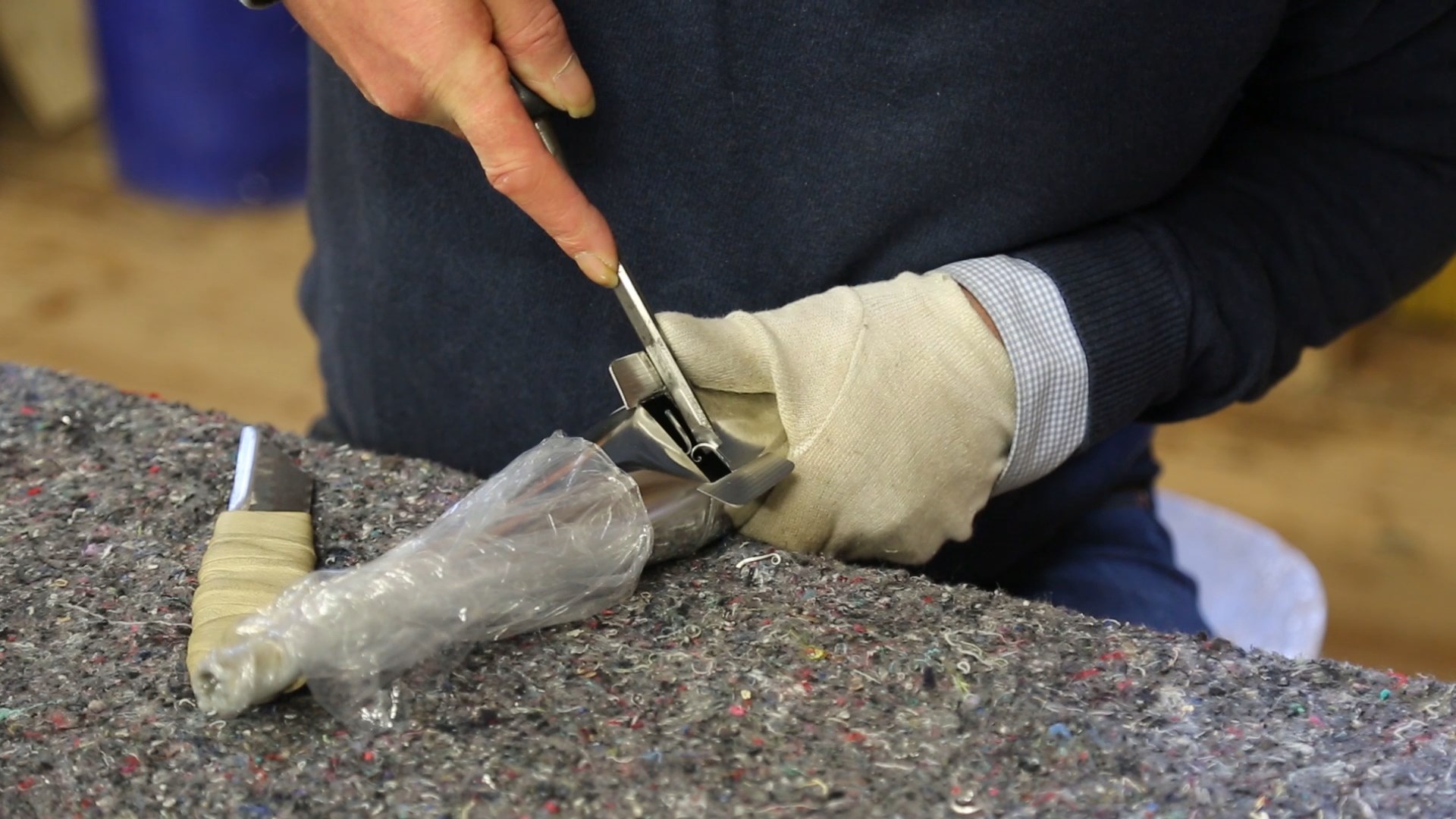
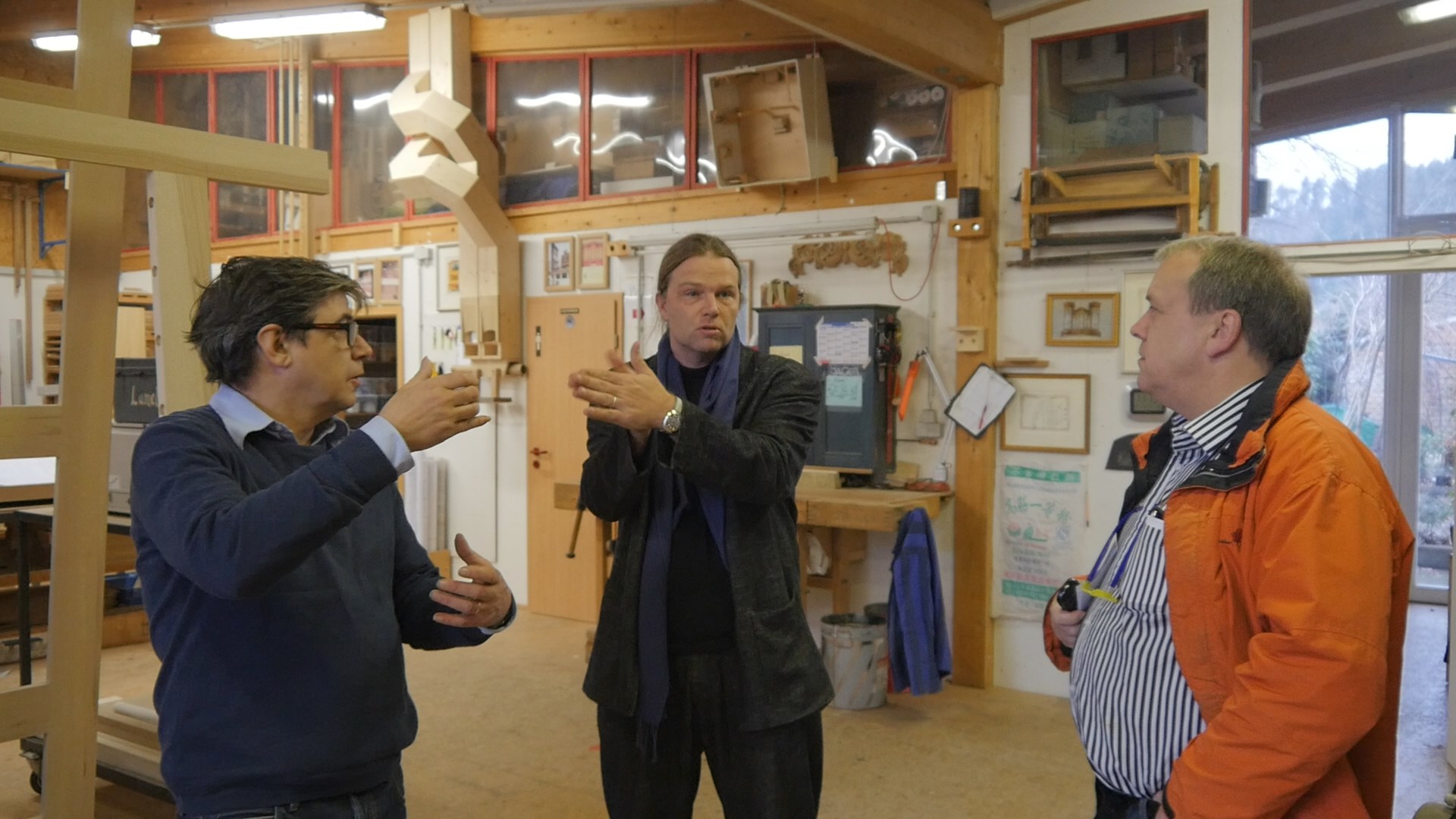
Aura calculata was realised in winter 2016 at imachination labs in collaboration with organ builders Jäger & Brommer from Waldkirch on the occasion of the exhibition XX oder der 'Mummelsee in der Pfanne' (XX or Mummelsee in the Pan) at the Municipal Gallery in Offenburg.

ⓘ Acrylic glass, metal pipes, aluminium half-clamps, valves, wind system with bellows, hoses, microelectronics (Arduino), LED, distilled water, pump, cables, low-voltage power supply, approx. 2*2.5 m
Logical Fantasies (2019) On the occasion of the solo exhibition at the Kunsthalle Jesuitenkirche, aura calculata enters into a dialogue with the secularised Baroque sacred building. The water organ is enthroned, so to speak, in the apse, where it sounds for around 10 minutes every half hour. Thanks to a revised control technology, the wind starts up very gradually, so that the sounds of the pipes slowly form in the room, more or less out of nowhere. The drama is further enhanced by the rhythm of the opening and closing water valves, which alternately accelerate and slow down again. At the end of the cycle, the sounds fade away with the dying wind. Only the changing lights and the clicking of the valves remain.
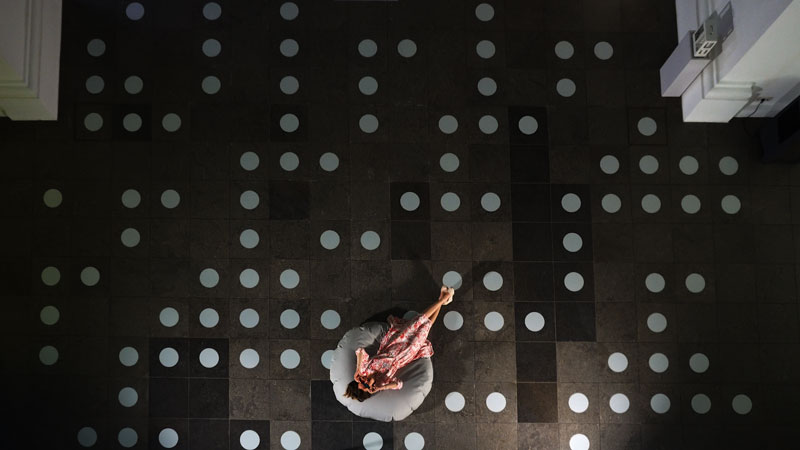


Cyberfloor The cybernetic logic of the water organ also takes over the church interior in a completely different way: analogous to the 18 pipes, a floor ornament with a width of 18 floor tiles spreads from the apse through the nave, giving the Kunsthalle a new appearance. The pattern of retro-reflective floor dots applied to the tiles follows the rule that drives the organ (Wolfram Code 30). The MaSo-Knüpfwerk, which hangs freely in the space not far from aura calculata, also owes its genesis to the fractal-like patterns of a similar self-organising rule.

ⓘ Approximately 200 circles made of adhesive retro-reflective foil, diameter 30 cm, total area approx. 8 x 35 metres
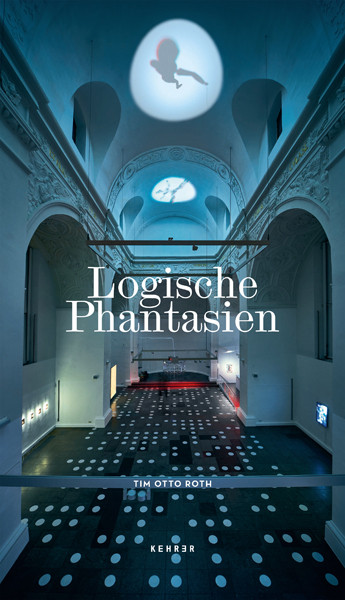 Logische Phantasien. Mit Beiträgen von Sebastian Baden, Thomas Richter and Barbara Maria Stafford, Heidelberg:
Kehrer Verlag 2020.
Logische Phantasien. Mit Beiträgen von Sebastian Baden, Thomas Richter and Barbara Maria Stafford, Heidelberg:
Kehrer Verlag 2020.
 Peter Weibel: Soundart. Sound as a Medium of Art, MIT Press 2019, S. 388-393.
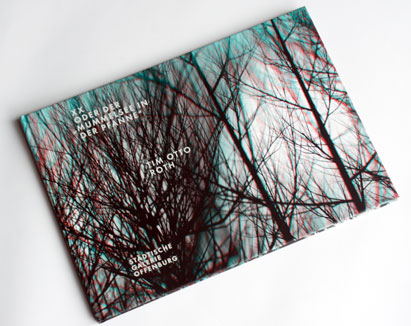
XX oder der 'Mummelsee in der Pfanne'. Mit einer Einführung von Karin Leonhard, Offenburg 2016.