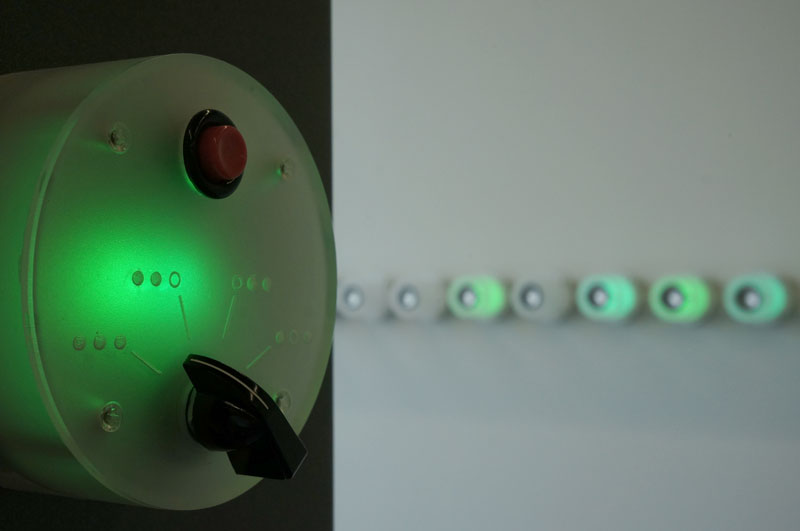
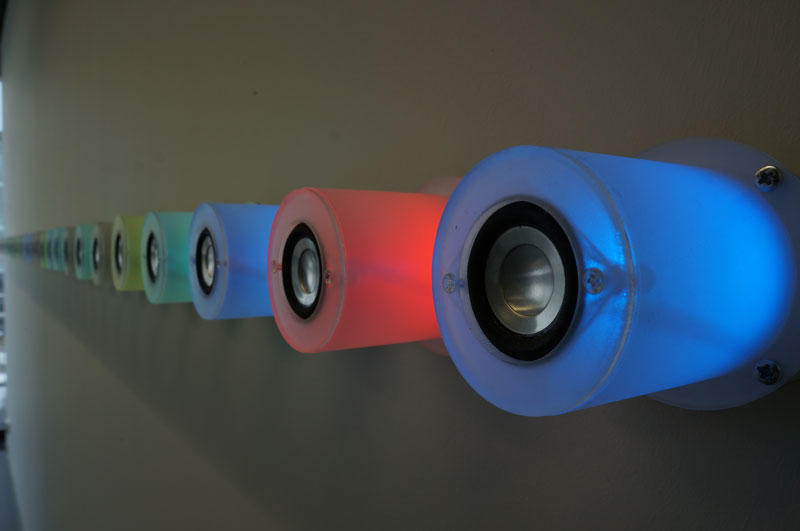
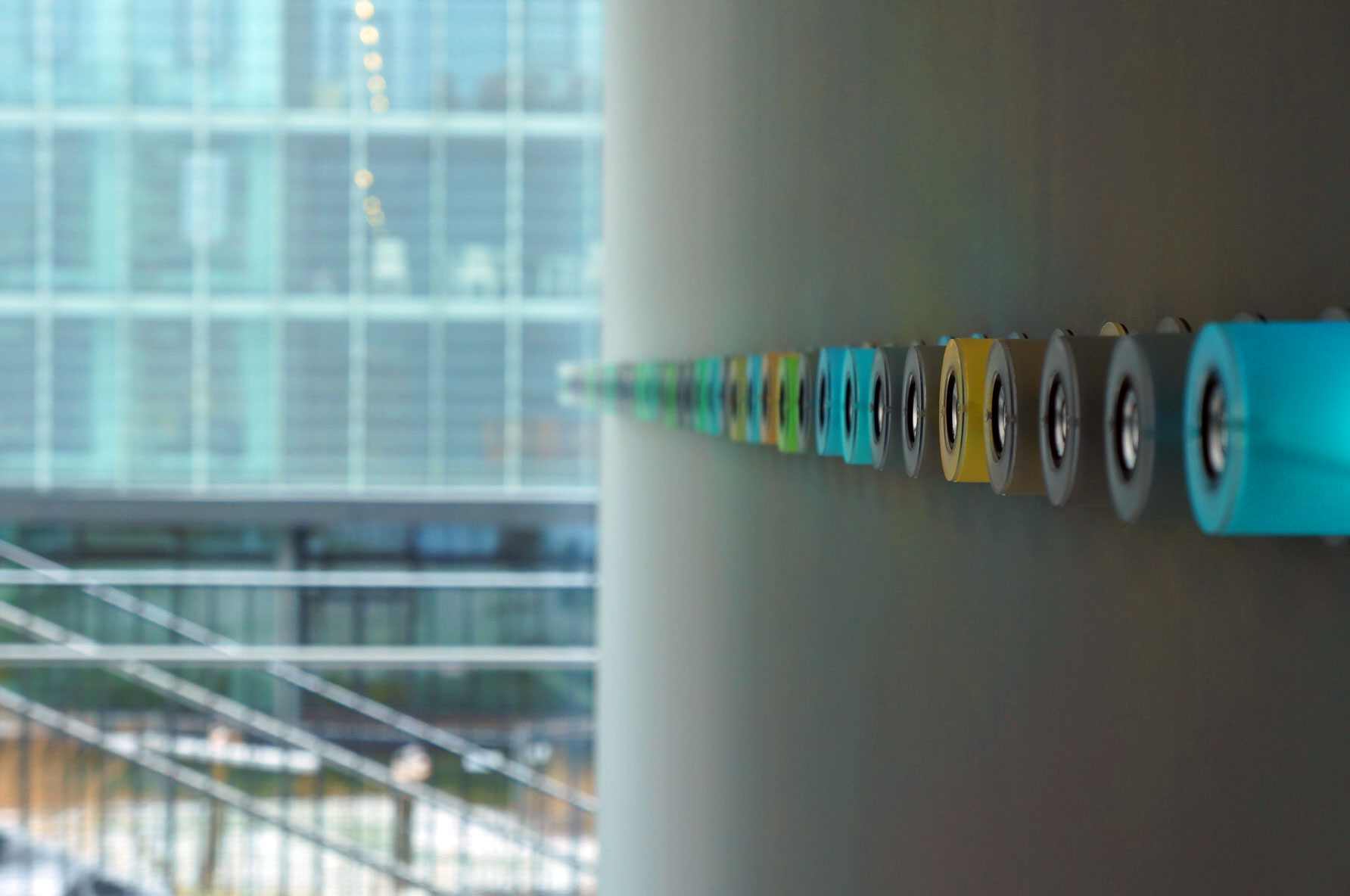
Soundpixel A loudspeaker version of aura calculata was designed in 2015 as a permanent sound installation for the foyer of the Lehmann Computer Centre at TU Dresden. A total of 39 loudspeaker sculptures made of translucent acrylic glass – known as sound pixels – communicate locally with their neighbours via cable connections. Each loudspeaker follows the same additive rule that dictates how it should respond to the activity of its two neighbours – a similar principle that also underlies the Mexican wave in a stadium.
Aura calculata at the data center at the Lehmann Center of the TU Dresden is powered by Bull GmbH.
ⓘ 39 sound pixels made of translucent acrylic glass (approx. 8*9 cm), speaker electronics, LED, cable, control unit (Atmel), motion detector, low-voltage power supply, width approx. 400 cm.
Activity = Timbre When a sound pixel is active, it lights up in one colour and plays a sine wave tone. At the beginning, all active sound pixels play the same sine wave tone at concert pitch A (440 Hz) and light up green. Analogous to the changing water levels in the pipes of a water organ, the pitch and, coupled with it, the colour of the sound pixels change depending on their activity. Without a central conductor, this change in attractors weaves a self-organising tapestry of timbres, in which the sine waves are recomposed locally into different sounds with an organ-like timbre.
Metric logic The dynamics of timbre are also unusual in that, based on the water levels in the organ pipes, the pitches change not logarithmically but metrically in millimetre increments: while in the low range the audible tone differences become smaller and smaller until they are microtonally indistinguishable, in the high range the tone jumps become larger and larger.
The pulsating control, which sets a clock speed that varies in speed, also allows you to choose between four different neighbourhood rules.
If a sound pixel was predominantly on in the last few steps, the pitch changes upwards and shifts the colour spectrally towards blue.
If a sound pixel was less active, it lowers the frequency. The deeper the tones become, the more the colour shifts from yellow to red.
Self-organising composition The timbre dynamics of aura calculata are characterised by the fact that individual sound pixels radically change their attractors over time, allowing them to vary in pitch. When a sound pixel reaches a lower or upper limit tone, the entire system is reset to its initial state. What is special about this self-organising composition is that the unfolding soundscape only reaches the lower or upper limit after a relatively long time.
Beyond chance What appears random to an outsider follows a simple but stringent feedback logic: each individual development step is the logical consequence resulting from the combination of the system's initial states and the neighbourhood rule that has been set. However, this deterministic development dynamic can be varied depending on the choice of rule and the initial state, which is set via a small switch on the sound pixels and determines whether the loudspeaker is on or off during initialisation.
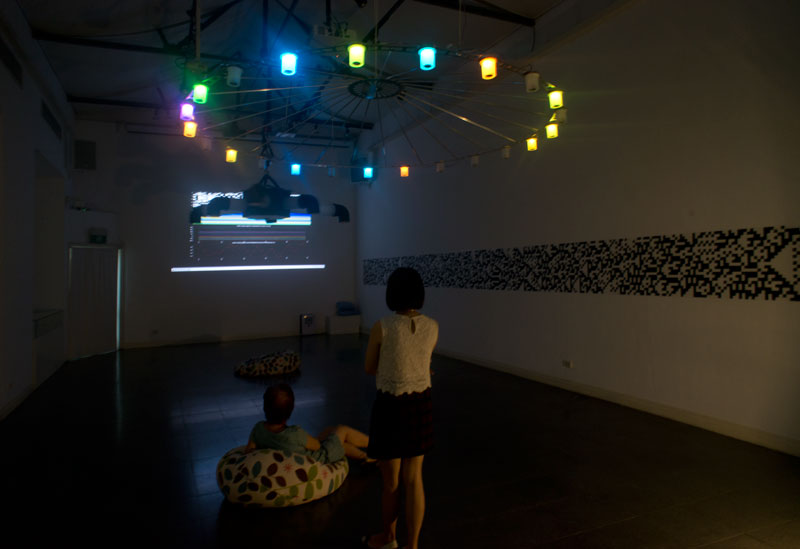
No. 23 – the chandelier edition (Hanoi 2017) For the exhibition Circulating Sounds – Deep Doppler meets mathematical socialism , a mobile exhibition variant with 23 sound pixels was created for the jubilee exhibition marking the 30th anniversary of the Goethe Institute in Hanoi. For this commissioned production, Roth designed a kinetic sound sculpture as well as a chandelier-like hanging structure made of laser-cut aluminium to hold aura calculata with 23 sound pixels.
Dynamics of prime numbers Despite the reduced number of sound pixels, the work unfolds an extraordinary dynamic range of timbres. This is partly due to the fact that Roth not only chose a prime number for the number of loudspeakers, but also based the pitch changes on prime number-based microtonal scales, such as a 31- or 53-tone scale. In addition to organ-like sine tones, filtered triangular waves with their mechanical sound are also used.
The twelve-metre-long printed wallpaper strip allows you to follow the pattern-rich developmental dynamics of the on and off states of the sound pixels from right to left in the form of 23 vertically arranged black and white pixels.
Fever curve This edition, shown for the first time at the Goethe Institute in Hanoi, highlights Roth's systematic study of the behaviour of cellular automata and his decision to learn Python programming specifically for this purpose. The result is evident not only in a wider range of different rules used in the composition. The presentation is also enriched by a visualisation projected onto the front wall of the exhibition hall, in which the development of activity can be followed in a fever curve-like representation.
ⓘ Control system (PC), laser-cut aluminium, cables, translucent acrylic glass, loudspeaker chassis, loudspeaker electronics, LED, low-voltage power supply, approx. 250 * 250 * 50 cm
N°23 with Silence (Marburg 2020) For the exhibition das erste mal ZUM ZWEITEN MAL (the first time FOR THE SECOND TIME) at the Marburger Kunstverein in spring 2020, the chandelier edition of aura calculata was presented in two modes: microtonal coloured sequences alternated with a mode without sound, showing only white glowing active sound pixels.
The group exhibition also featured two MaSo knotted works, whose patterns were created by North Indian weavers who did not follow a preconfigured map, but instead applied a simple neighbourhood rule to determine the colour of the knots to be tied.
ⓘ control technics (RPI), laser-cut aluminium, cables, translucent acrylic glass, loudspeaker chassis, loudspeaker electronics, LED, low-voltage power supply, 250*250*50 cm.